

My new book, The Longer Road is about to launch. As an introductory offer, the digital version will be free for 3 days over the weekend. Here is a link:
The Longer Road - Kindle Version
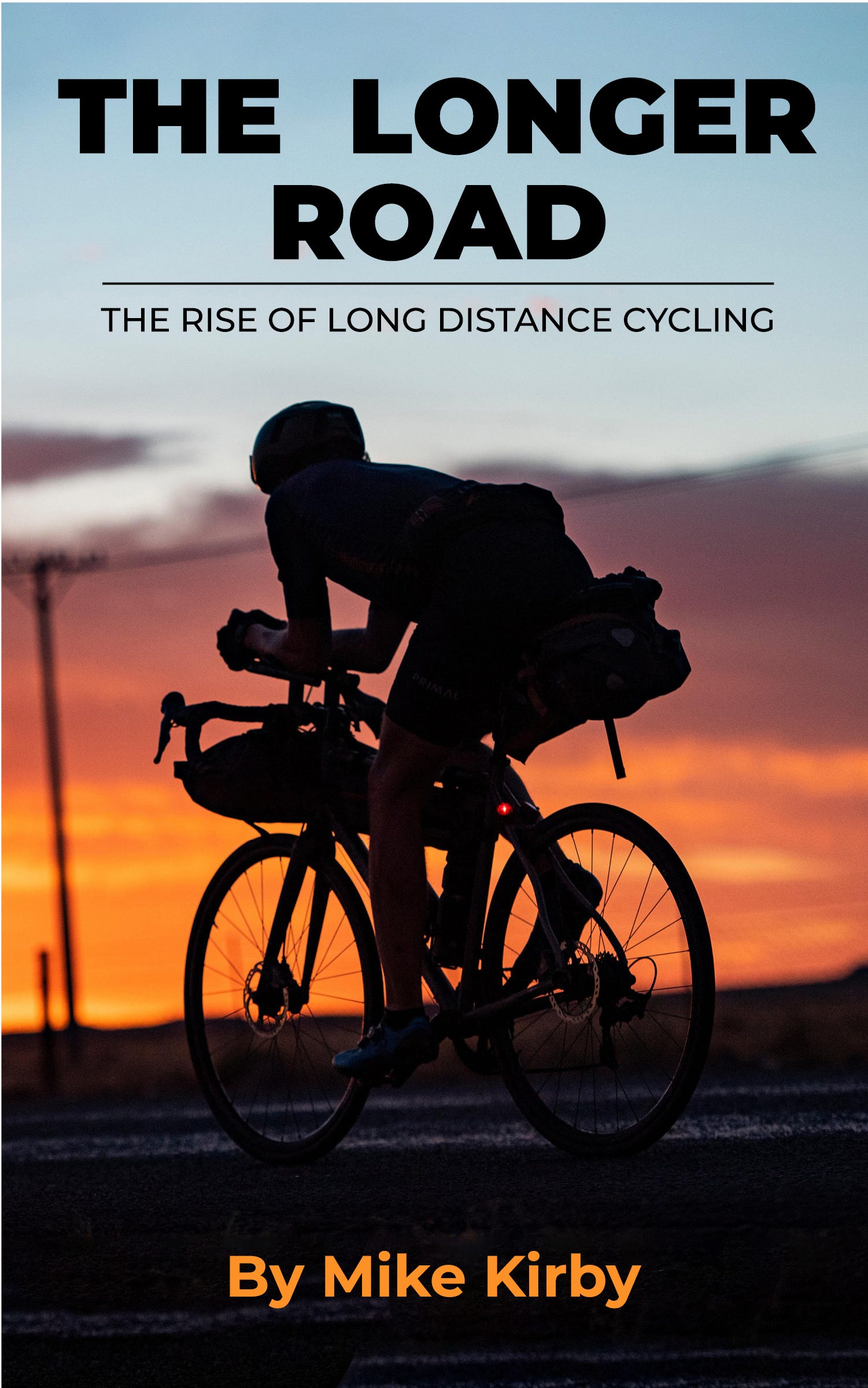
Here is an extract on training for a long day or multi-day ride:
Unless you are the kind of ultra rider who can get by on a ride to the pub, a few pints and a ride home, then training is likely to be something you should, and even want to do.
It is always a surprise to read posts on social media from people who, only weeks before an event, profess to having done no training at all. The ability to undertake a long race, with only a few training rides is enviable.
I have done several long distance rides with my son, for most of which he failed to do any/much training. I still had trouble keeping up with him even in his unfit state, now only able to compete when he is ill or hung-over, or both.
Training has to be taken seriously for me. Luckily, I love the post ride feeling, legs, slightly tight, but in a good way, you can almost feel the blood coursing through, and lungs that you can properly fill with the good air. When I took up time trialing with all the passion of the newly converted, I much preferred to train rather than race.
I am not one for poring over the numbers. I had a power-meter, long before learning to use it for anything other than to tell the time. Looking at the power stats on a ride, there are so many other variables. I prefer perceived effort as this takes into account training load and levels of fatigue.
A bank holiday weekend is a gift and with a big race coming up. The plan is three consecutive two hundred kilometre days. A good weekend can be two lots of three hundred kilometres. Luckily my partners chosen sport of long distance swimming is almost as time consuming as mine.
It is over consecutive days that we learn the effects riding long distances has on the body. You can do as many three or four hour training rides as you like and still not get close to the changes that happen when you string long days together. It is not necessary to ride for ten consecutive long days to prepare for a race with ten consecutive long days, but my contention is that you need to know what riding for days in a row, feels like.
Trans-Continental Race winner James Hayden says that ‘I would do three-to-four-hour rides, a few interval sessions and some longer aerobic intervals. The key is to be really consistent with training’ He adds that ‘I also do pre-hab and rehab exercises and spend a lot of time and money at the physio and the osteopath. Yoga is also very valuable.’
For Mark Beaumont, training for endurance rides meant long hours at zone 2. In preparation for his record breaking feats, he trained through the ranges to push up functional threshold power and endurance, then building conditioning with longer rides closer to the events. This gives Mark a far better resilience to injury and allows him to ride harder for longer.
NorthCape4000 winner Ian Walker, in his preparation for the attempt on the northern tip to the southernmost tip of Europe, managed to combine his eighty kilometre round trip ride to work into his schedule (out of necessity, rather than choice). He undertook these rides at what he describes as ‘a plod’, but for most of us would be called zone 2, his effort measured by his heart rate. He too added interval training at specific power levels too.
After the 2024 Pan Celtic Race, I spoke to Rachel Nolan who won the women’s race the finished sixth overall and to Dave Scott, the outright winner. For Rachel, it is not so much the physical effort of a race like this, but the psychological approach where the battle lines are drawn. It is less about power in the legs, though that helps, more an act of will power in its very purest form. The will to minimise the interruptions to forward progress is key.
For Rachel, ‘having her head in the right place’ at the start can be more important than physical preparation. She is clear that having the right mental attitude to enjoy the experience is key. She uses time on the road to stay in touch with herself, to be in the moment, and to connect to nature and people around her. She checked out a lot of the PCR route before the event as part of her training and chose to try and sleep in a bed every night, usually clocking up between 1 and 4 hours to give her body chance to recover.
Dave Scott had ridden two previous Pan Celtic races before taking the win in 2024, which he told me was by far the toughest. During the race, he fell and gashed his knee, was bitten by a dog and bent his rear gear mech when he fell on the Mull of Kintyre, smashing his phone at the same time.
In preparation, Dave increased his training volume and clocked up long, single day rides like the Majorca 312 and the well named Yorkshire Beast, which at three hundred kilometres rightly lays claim to being one of the toughest Sportives in the calendar. Dave’s sage advice to all those contemplating an ultra, is not to over think things.
*
I suspect quite a lot of my training for the pure enjoyment of just doing it. By the end of summer, as autumn starts to show its first colours and the fruity wine like smells, intensify, mingling with that earthy, shroomy, smell, I start to plan my winter training, tracing routes with my finger on my Ordnance Survey maps, living in the map, escaping to countryside further away, imagining what I might find, reading the contours and following the red, green and yellow lines of roads, paths and trails. My older maps have what appear to be random dots that I must have made once with good reason, often accompanied by illegible writing. I dredge my memory for the things I found there that were remarkable and noteworthy for me on that day.
My aim is to try to build resilience, both physical and mental. I have found no replacement for running or riding a long way. This involves the same routes at times, the ones I have done for more than ten years now. Knowing each contour, where the going is good to soft under my wheels or where a neglected back road is too broken-up to ride safely, is valuable and the familiar is comforting.
The joy of training is to know these routes. To remember where the sun will be at a certain time, the colours, the light and the shade. and how these change with the time of day, the weather and the season.
‘Don’t you get bored?’ a friend asked. With so much to appreciate crossing the countryside, the answer is no, never. As Haruki Murakami says, ‘no matter how mundane some actions might seem, keep at it long enough and it becomes contemplative, even meditative’. This is how I feel riding my bike along familiar routes.
*
Finally, while it was always good to have companionship, when I train I need to set my own tempo, test myself to my own clock, to stop and refuel when I need to. It allows me to relax into a ride, to achieve ‘flow’, for the ride to become almost effortless. Real fatigue doesn’t hit until the ride is over.
Runners talk about a ‘god run’. You feel you can run at pace, all day, and just keep going. Most of us will have glimpsed this on a handful of occasions. Long training rides allow me to find that meditative state when the world slows down. This is the very definition of Zen. Calm attentiveness, guided by intuition, being in the zone, lost in the rhythm, feeling the flow.
*
Please pick up your free copy of the book this weekend.
Thanks and best wishes,
Mike